Peptide Screening: Hplc & Mass Spec Pureness Overview Pinnacle
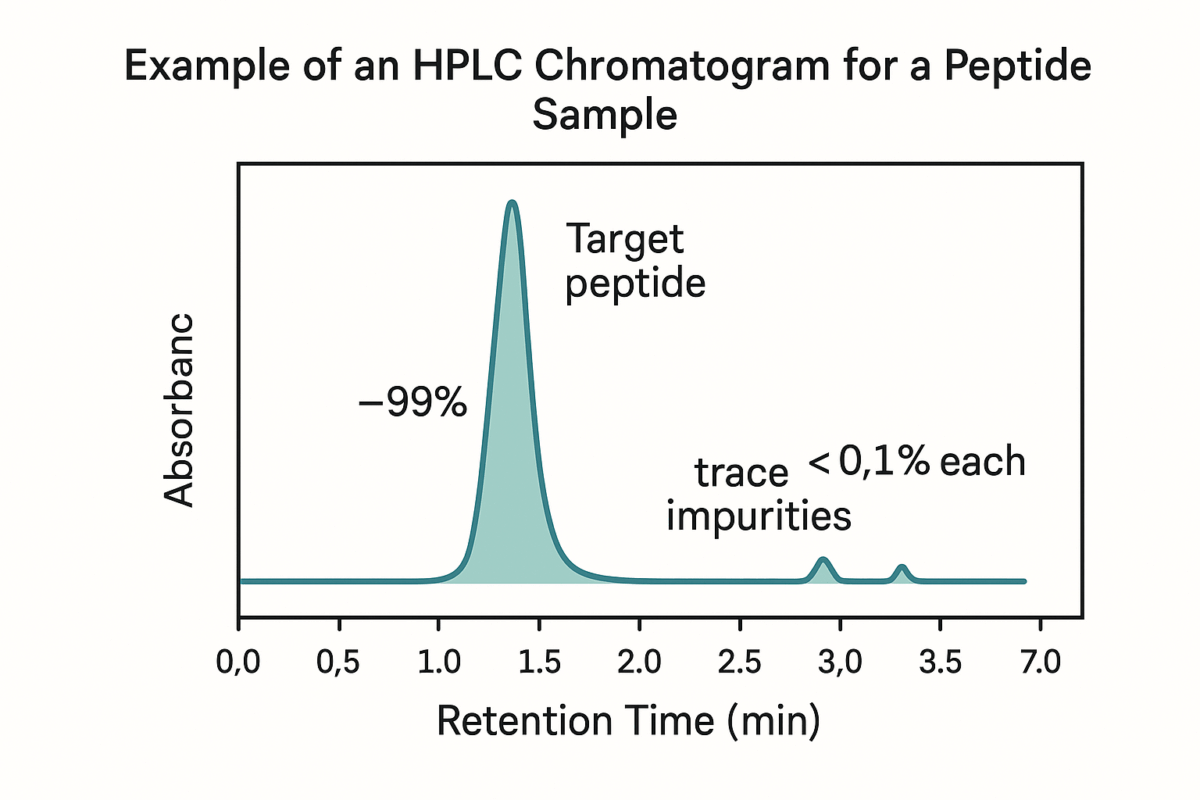
A/c Peptide Screening Labs Third-party Peptide Analysis We will certainly choose one of the most appropriate elution https://direct-peptides.com/ solvent for you according to your example attributes, sample kind and the solvent you make use of to dissolve the example. Initially, a little amount of the peptide is liquified in a liquid and infused right into the HPLC machine. That liquid is then pushed through a narrow tube (called a column) under high pressure. For assay reproducibility, HPLC Method Advancement relies on the best mix of pumps, logical columns and pre-columns, mobile phase, and autosampler problems. HPLC Technique Validation ensures proper assay selectivity, level of sensitivity, and reproducibility. We see analytical data not as a deliverable to be "supplied," but instead as a living artefact that needs to stand the test of time long after the invoice has been worked out. As a result, every solution component, be it a tailor-made pollutant profile, a stability protocol, or a regulatory dossier, is created for traceability, story-telling, and future-proofing. Every reliable peptide distributor gives a Certification of Evaluation (CoA) with each product. This paper ought to include the HPLC pureness percentage, the molecular weight confirmed by mass spectrometry, the peptide sequence, great deal number, and screening day. Scientists should examine these documents before integrating any type of peptide into their work. Chiral methods can deal with enantiomeric purity where stereochemistry is an issue. Residual-solvent or water-content tests can matter in production or security contexts. These are beneficial in the best setting, yet they need to be taken method-specific proof instead of an universal substitute for HPLC and MS. Peptide screening is effective, but researchers need to review the scope of each technique thoroughly.
- Mass spectrometry is a commonly made use of treatment observed as having exceptional sensitivity.
- The pureness of the peptide is validated by running analytical HPLC adhered to by mass range analysis.
- Normally, this fit-for-purpose method assists decrease the HPLC test cost substantially during very early exploration research studies.
- An efficient purity process balances speed, cost, and the level of logical certainty required.
Data Reports For Magazine Or Regulatory Usage
Peptides connect with a nonpolar fixed phase, separating based on hydrophobicity. Monitoring at 214 nm provides wide sensitivity since the peptide backbone soaks up highly at this wavelength. Independent confirmation through third-party labs removes conflicts of rate of interest that can jeopardize quality cases. When the very same firm both makes peptides and checks them, rewards exist to existing beneficial outcomes even when worldly quality fails.What Are The Criteria Needed For Ideal Quantitation Throughout A Hplc Research Study?
ESI-MS provides remarkable performance for intricate mixes or when MS/MS is required for sequence confirmation. Selecting the appropriate pureness from the beginning helps in reducing rework and preserves speculative uniformity across sets. Together, they create the basis of a Certification of Evaluation (COA) -- the official document that comes with genuine research-grade peptides. Without both, researchers can not be completely positive in the high quality or reproducibility of their work. When the item is authorised, the compliance pressure morphs from a burden of demonstration to a burden of maintenance. The yearly item testimonial must demonstrate that the confirmed approach remains to function as anticipated within its analytical guardrails; inconsistencies call for rehabilitative actions that are in turn investigated. Method transfer to a contract organisation needs side-by-side equivalence studies, since the regulators will certainly not accept a new lab just asserting that it is making use of "the same" column and mobile stage. Lastly, the recent emergence of formal ICH Q14 standards on analytical procedure development is advertising a lifecycle method in which validation is no more an one-time hurdle yet a living file constantly fine-tuned by real-time data. Thus regulative conformity is not an outside charge grafted onto peptide scientific research; it is the official language whereby analytical rigour is equated right into client defense and commercial longevity.How much does peptide HPLC screening expense?
The cost of peptide evaluation solution varies considerably based upon which methods your regulative bundle needs: HPLC-UV Evaluation: $& #x 24; 300 & #x 2013; & #x 24; 800 per example (standard purity analysis) LC-MS (Fluid Chromatography-Mass Spectrometry): $& #x 24; 600 & #x 2013; & #x 24; 1,500 per example (molecular weight verification).